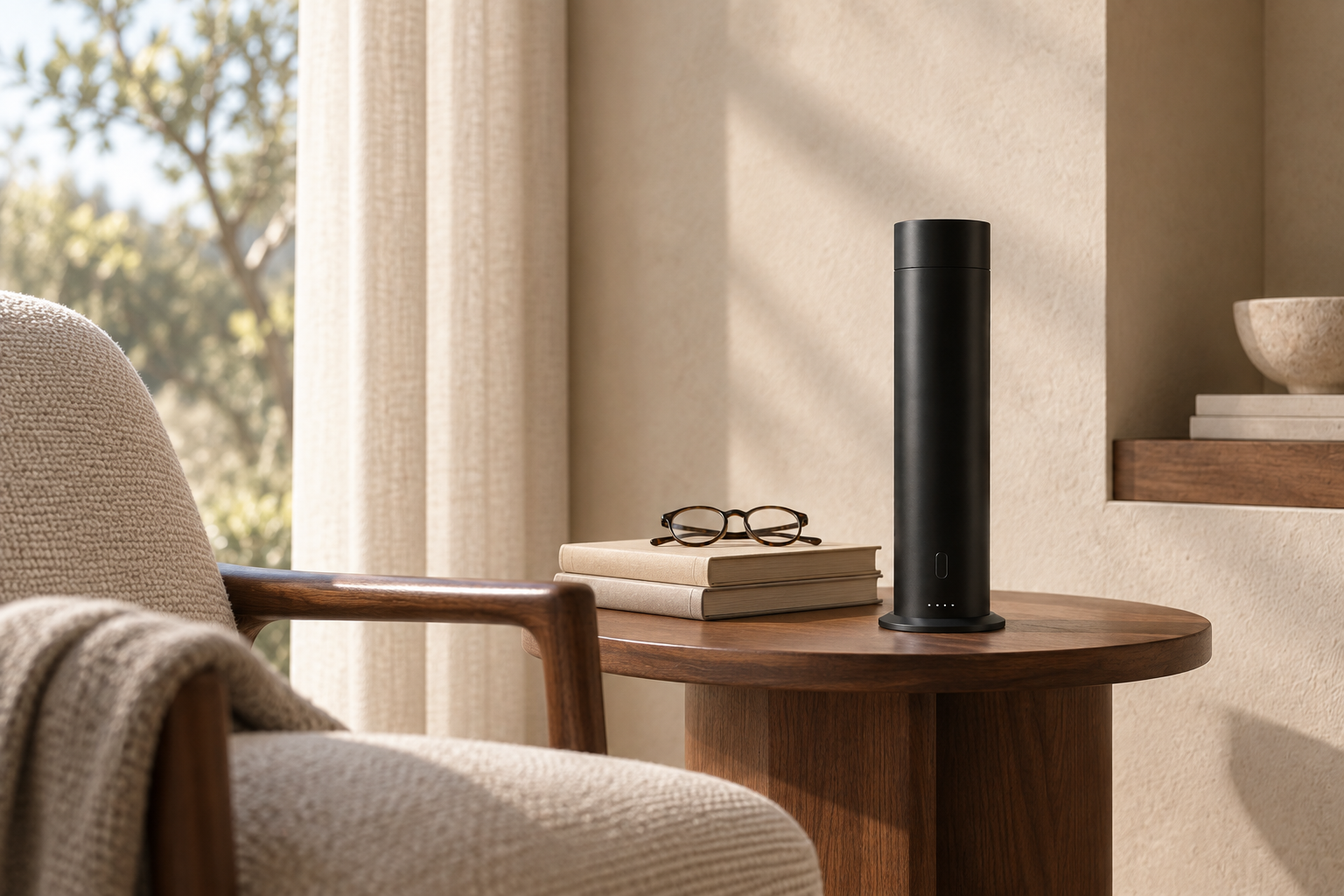
For years, ultrasonic diffusers have been one of the most familiar formats in home fragrance and wellness. They are easy to understand, visually expressive and closely associated with essential-oil routines.
Waterless diffusion developed along a different path.
Many waterless systems were first adopted in hospitality, retail and commercial scenting, where direct fragrance delivery, continuous operation and larger scenting requirements were important.
That distinction is now becoming less clear.
Waterless diffusion is no longer only a commercial technology. As products become smaller, quieter, easier to control and more design-led, it is becoming increasingly relevant to the home.
The question is therefore no longer simply:
Is waterless better for commercial spaces, while ultrasonic is better for the home?
A more useful question is:
Which scenting experience is right for the intended user, space, fragrance and product program?
For brands developing a diffuser program, the answer depends not only on atomization technology, but also on refill experience, maintenance, control, industrial design, fragrance compatibility and the way the product fits into everyday life.
How Ultrasonic Diffusion Works
Ultrasonic diffusers use high-frequency vibration to disperse a mixture of water and fragrance or essential oil into the air.
The visible mist is usually part of the experience.
For many consumers, this mist has become strongly associated with aromatherapy, wellness and relaxation. Lighting, timer functions and the ritual of adding water can also make the diffuser feel interactive and familiar.
This makes ultrasonic products particularly relevant when the diffuser is intended to remain visible and actively used as part of the room.
Typical applications include:
- home fragrance
- wellness
- spa environments
- bedrooms
- consumer retail
- private-label lifestyle products
Ultrasonic technology remains a strong platform because users generally understand how it works.
But the water reservoir also defines the maintenance experience.
Users need to refill water, clean the tank regularly and manage the balance between water and fragrance.
For some consumers, this is part of the ritual. For others, it is an additional maintenance step.
How Waterless Diffusion Works
Waterless diffusers disperse fragrance without adding water.
Depending on the product architecture, fragrance oil is delivered directly through an atomization system rather than being diluted in a water reservoir.
Historically, this approach became more common in commercial scenting because it could support direct and more continuous fragrance delivery.
But waterless technology should not automatically be treated as commercial equipment.
The technology itself is only one part of the product.
A large wall-mounted scenting system and a compact tabletop waterless diffuser may use related scent-delivery principles, but they create completely different user experiences.
This is where the category is changing.
Waterless Does Not Automatically Mean Essential-Oil Compatible
A waterless diffuser does not automatically mean a diffuser designed for undiluted essential oils.
Many waterless scenting systems are developed around fragrance oil or another specified fragrance medium.
Pure essential oils can place higher demands on the diffuser system.
Depending on the oil, differences in viscosity, composition and chemical characteristics can affect:
- atomization consistency
- pump performance
- seals and tubing
- plastic and elastomer compatibility
- residue formation
- cleaning requirements
- long-term reliability
A waterless diffuser designed for fragrance oil should not automatically be assumed to support pure essential oils.
Compatibility with undiluted essential oils depends on the specific diffuser design, atomization system and materials.
For product-development programs, the intended fragrance medium should be confirmed early rather than treated as an interchangeable input.
Why Waterless Diffusion Is Moving Into the Home
The opportunity for home waterless diffusion is not to place a commercial scent machine in a living room.
It is to redesign the advantages of waterless scenting around the expectations of a home user.
That means retaining useful elements of direct fragrance delivery while removing the equipment-like qualities traditionally associated with commercial systems.
Several changes make this possible.
Smaller Form Factors
Waterless scenting systems no longer need to be large.
Compact tabletop and plug-in formats allow direct fragrance delivery to move into bedrooms, living rooms, home offices and other everyday spaces.
For home use, the target is not maximum scenting capacity.
The product needs to be appropriately scaled for the room and the user.
Lower Noise
Noise that may disappear into the background of a hotel lobby or retail environment can become noticeable beside a bed, desk or sofa.
For consumer use, pump selection, vibration control, enclosure design and operating cycles become much more important.
A technically functional scenting system is not automatically a good home product.
Simpler Controls
Commercial systems may use complex schedules, remote management or installation-specific controls.
Most home users need fewer decisions.
Timer settings, fragrance intensity and simple local or app-based control may be enough.
The goal is not to add as many functions as possible.
It is to make the scenting experience easier to understand.
Better Industrial Design
A home diffuser becomes part of the interior.
Material, finish, proportion and visual integration matter as much as technical performance.
A waterless diffuser that looks like professional equipment may function perfectly but still feel inappropriate in a living environment.
This creates opportunities for:
- softer forms
- textile or fabric finishes
- compact plug-in formats
- furniture-friendly proportions
- quieter visual language
- less technical-looking controls
A fabric-wrapped tabletop format illustrates how material choices can help a diffuser sit more naturally within an interior, while a compact cylindrical platform offers a more discreet expression of direct fragrance delivery.
Better Refill Experience
Waterless technology also creates a different opportunity around fragrance refills.
For a brand, the refill is not simply a consumable component.
It can become part of the customer relationship and the commercial model.
Bottle design, refill installation, fragrance selection, replacement frequency and packaging all affect whether the product feels convenient or complicated.
The home opportunity is therefore not simply about atomization.
It is about the complete product experience around the technology.
Waterless vs Ultrasonic: Key Differences
| Consideration | Waterless Diffusers | Ultrasonic Diffusers |
|---|---|---|
| Water required | No | Yes |
| Typical scent medium | Usually specified fragrance oil / compatible fragrance medium | Water with compatible essential oil or water-compatible fragrance |
| Visible mist | Usually minimal or absent | Usually visible |
| User familiarity | Growing | Very familiar |
| Home suitability | Increasing potential as products become smaller, quieter and easier to use | Established |
| Maintenance | Refill and atomization-system care | Water tank cleaning and reservoir care |
| Product experience | Can be discreet, refill-led and design-focused | Often visual, interactive and wellness-led |
| Scent delivery | Direct fragrance delivery | Water-based diffusion |
| Controls | May include local control, remote, timer or app | Commonly timer, lighting and local control |
| Refill opportunity | Strong | Depends on product format |
| Pure essential oil compatibility | Must be confirmed by product | Commonly used in diluted water-based application |
| OEM potential | Strong for fragrance brands and home-scent programs | Strong for lifestyle and wellness programs |
Neither platform is universally better.
They are optimized around different user experiences and technical requirements.
The Traditional View: Waterless for Commercial, Ultrasonic for Home
There is still some truth in this distinction.
Large waterless systems remain useful for:
- hotels
- retail environments
- reception areas
- public interiors
- larger scenting programs
Ultrasonic products remain well suited to:
- wellness
- home use
- spa rituals
- consumer lifestyle products
But treating this as a permanent division misses an important product-development opportunity.
Commercial scenting has already solved many technical challenges around direct fragrance delivery.
The next opportunity is to translate selected advantages of that technology into products designed around home users.
That is primarily a product-design challenge rather than simply a technology challenge.
What a Home Waterless Diffuser Needs to Do Differently
A home waterless diffuser should not be judged primarily by maximum coverage.
In fact, excessive scenting power can be a disadvantage in smaller spaces.
A consumer product needs to balance several factors.
Appropriate Scent Output
The goal is not to scent the largest possible area.
The goal is to create a comfortable and controllable fragrance level in a real living environment.
A home user should be able to reduce intensity easily rather than manage a system designed around commercial-scale output.
Quiet Operation
Mechanical noise that is acceptable in a public environment can become distracting in a bedroom or home office.
Low-noise operation should therefore be treated as part of product experience, not merely a technical specification.
Easy Refilling
The fragrance bottle should be easy to access, remove, replace and understand.
Users should not need technical knowledge to maintain the product.
Refilling is part of the product experience.
Simple Intensity Control
Consumers need an intuitive way to make the fragrance lighter or stronger.
Professional-style programming can add unnecessary friction.
A smaller number of well-designed control options may create a better user experience than a long feature list.
Visual Integration
The diffuser should look intentional in the room.
This may involve more refined materials, softer proportions, textile finishes, smaller product footprints or controls that feel less industrial.
Fragrance Compatibility
The fragrance system should be considered together with the hardware.
If the intended medium is fragrance oil, the atomization system and material selection should be designed and tested around that fragrance profile.
If pure essential oils are part of the program, compatibility requires separate evaluation.
Fragrance viscosity, formulation and material interaction can significantly affect atomization performance and long-term reliability.
Appropriate Price Architecture
Commercial technology only becomes meaningful in the home if the hardware, refill and long-term ownership model also make sense for consumers.
This includes:
- hardware price
- refill price
- refill frequency
- fragrance consumption
- packaging
- replacement experience
The product cannot be evaluated independently from its refill ecosystem.
Maintenance: Different, Not Necessarily Less
Waterless diffusers remove the need for a water reservoir, but they are not maintenance-free.
Depending on the fragrance and system design, atomization components may require cleaning.
Fragrance viscosity and formulation can also affect residue and long-term performance.
Ultrasonic systems have their own routine:
- refill water
- add fragrance or essential oil
- clean the reservoir
- manage residue
- consider water quality
The better choice depends on which maintenance experience is more appropriate for the intended user.
For a consumer brand, this should be considered during product development rather than explained only after launch.
Coverage Is a Planning Reference, Not a Precise Specification
Coverage figures are useful for initial comparison, but they should not be treated as exact performance measurements.
Practical scent coverage can change significantly depending on:
- room layout
- ceiling height
- airflow
- HVAC
- open doors and windows
- fragrance formulation
- fragrance concentration
- fragrance viscosity
- operating intensity
- diffuser placement
This is why rounded supplier-rated coverage ranges are often more useful than mathematically precise figures.
For home scenting in particular, maximum coverage may be less important than controllability and comfort.
A diffuser that can technically scent a large area may still need to operate at a much lower intensity in a bedroom or living room.
The correct question is not:
How many square feet can this diffuser cover at maximum?
It is:
Can the diffuser create the right scent level for the intended room and user?
Which Platform Is Better for Home Use?
Ultrasonic remains the more familiar home technology.
It is a strong choice when:
- visible mist is part of the desired experience
- the brand has a wellness or aromatherapy positioning
- users are comfortable with adding water
- lighting and mist are part of the product ritual
- the product is intended to feel interactive
Waterless becomes increasingly attractive when:
- users want fragrance without adding water
- a refill-based system is important
- the product needs to feel discreet
- direct fragrance delivery is desirable
- consistent everyday scenting matters
- the diffuser is specifically designed for home-scale noise and output
- the brand wants a differentiated scenting system rather than another conventional ultrasonic diffuser
For fragrance and home-lifestyle brands, this last point can be particularly important.
Waterless technology can create a different product proposition rather than simply another diffuser variation. Brands comparing current formats can explore Auramist’s waterless diffuser platform and the representative ultrasonic platform in more detail.
OEM and Brand Program Considerations
The choice between waterless and ultrasonic should also reflect the commercial program around the product.
Important questions include:
- What fragrance medium will the product use?
- Is the fragrance formulation already defined?
- Is pure essential oil compatibility required?
- What should the refill experience feel like?
- Will the fragrance be proprietary?
- Should the diffuser remain visible?
- How much control does the user actually need?
- Is the product sold as hardware, as part of a fragrance system, or both?
- What price level is appropriate?
- How should packaging explain the technology?
- Which power configuration is required?
- Which markets will the product enter?
Fragrance compatibility should be confirmed early in product development.
A system developed for fragrance oil may not automatically be appropriate for undiluted essential oils.
Available customization may include housing, finish, controls, refill configuration, packaging, instructions and power configuration depending on the selected platform and supplier.
Specific OEM options should be confirmed project by project.
The right product is therefore not simply the one with the strongest technical specification.
It is the one that fits the intended customer, fragrance system and business model. Auramist’s OEM and ODM diffuser programs and fragrance brand diffuser programs provide two starting points for that development work.
What About Commercial Scenting Systems?
Commercial scenting systems remain relevant for larger-scale coverage, HVAC integration, centralized control and longer operating cycles. They also remain a source of technical knowledge.
But they should not define the entire future of waterless diffusion.
The opportunity sits between commercial equipment and ultrasonic home diffusers: compact tabletop and plug-in systems, quieter pumps, simpler controls, design-led housings and refill-based home fragrance programs. This is where waterless technology begins to become a consumer product category rather than simply a commercial scenting technology.
The Bigger Opportunity
The future of home scenting may not be defined by one technology replacing another.
Ultrasonic diffusion will continue to have a strong place in wellness and home fragrance.
But waterless technology creates another path.
As hardware becomes smaller, quieter and more visually considered, some of the principles developed for commercial scent delivery can be translated into products designed specifically for daily home use.
The opportunity is not to make commercial scent machines smaller. It is to rethink the entire waterless scenting experience for the home.
For brands, that means looking beyond the diffuser itself and considering the relationship between:
- fragrance
- hardware
- atomization
- refill
- controls
- industrial design
- packaging
- maintenance
- material compatibility
- customer experience
That is where a waterless diffuser can become more than a piece of equipment.
It can become a complete home scenting system.