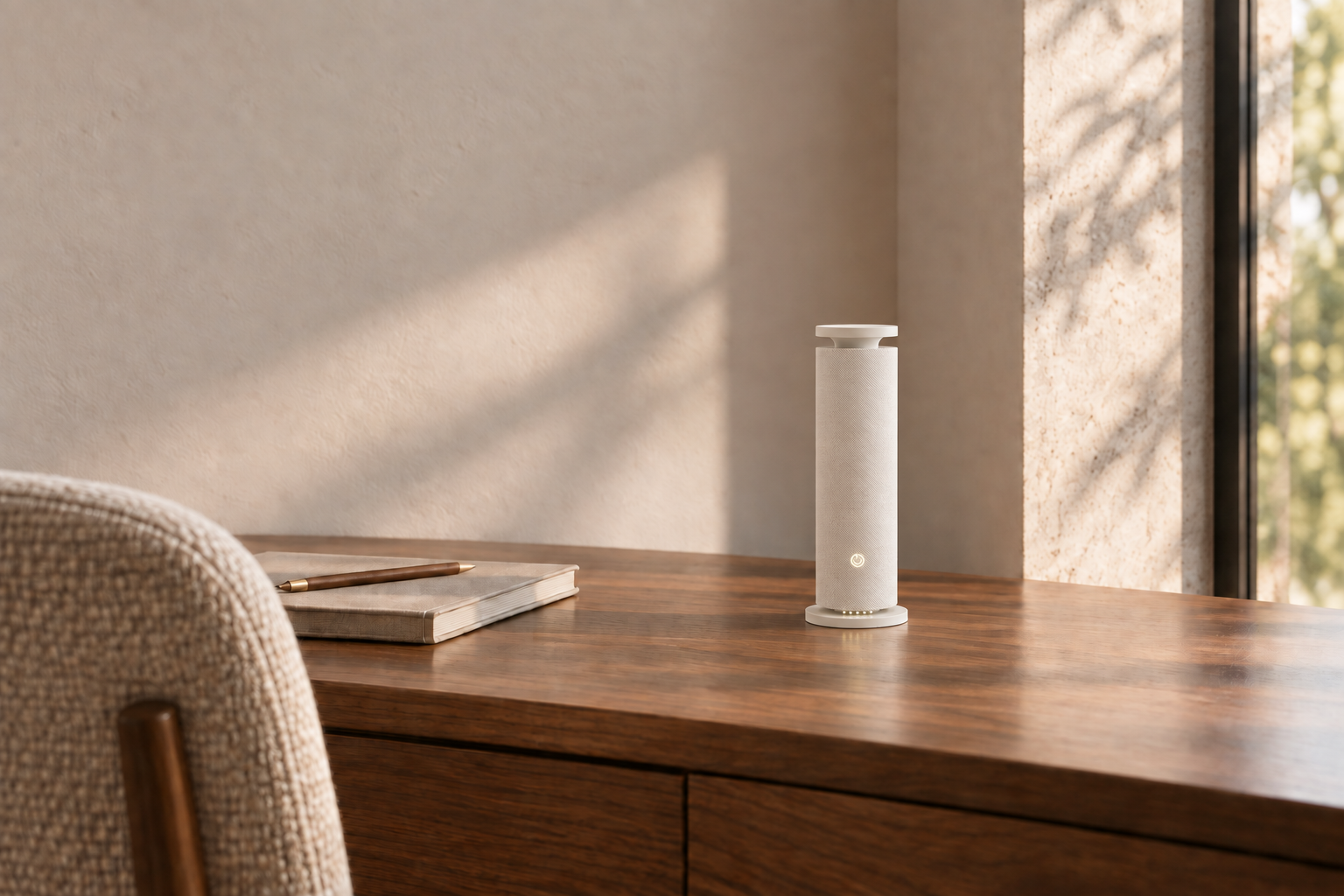
For many years, waterless scenting was associated primarily with hotels, retail spaces and other commercial environments.
That made sense. Commercial systems were developed around priorities such as direct fragrance delivery, longer operating cycles and broader scent coverage. The technology was effective, but the products often felt like equipment.
Home fragrance evolved differently.
Ultrasonic diffusers became familiar because they were compact, visually expressive and easy for consumers to understand. Water, visible mist, lighting and essential-oil routines became part of the experience.
Today, there is more room between these two categories.
As waterless products become smaller, quieter, easier to operate and more thoughtfully designed, direct fragrance delivery becomes increasingly relevant to everyday home use.
The next phase of waterless scenting is not about bringing commercial equipment into the home.
It is about creating smaller, simpler, more portable and more beautifully designed scent devices for everyday living.
From Scenting Equipment to an Everyday Home Device
A successful home waterless diffuser should not be judged by the same criteria as a commercial scenting system.
Maximum coverage is no longer the main question.
For home users, practical considerations become just as important:
- Is it easy to use?
- Is it quiet enough for everyday living?
- Can it be placed where people actually want scent?
- Does it fit naturally into the interior?
- Is fragrance intensity easy to control?
- Is refilling simple?
This shifts product development away from technical capability alone and toward the complete user experience.
Smaller Hardware Changes the Role of the Product
Size changes where scenting can live.
A commercial scenting system is often installed in a fixed position and treated as part of the operational environment.
A compact waterless diffuser can sit naturally on a side table, shelf, desk or console.
That changes the relationship between the user and the device.
Instead of being hidden as equipment, the diffuser becomes part of the room.
Smaller scale also gives brands more freedom to rethink industrial design, materials, controls, packaging and retail presentation.
The product no longer needs to look like commercial machinery simply because the scent-delivery technology originated in commercial applications.
Portability Makes Scenting More Flexible
Home use is dynamic.
People use different rooms at different times of day, and scenting needs may change with those routines.
For suitable compact tabletop formats, portability can therefore become part of the product value.
A diffuser can move from a home office during the day to a living space later on, rather than being treated as permanently installed equipment.
This flexibility also changes the importance of maximum coverage.
For many home applications, the more relevant question is whether the diffuser can create an appropriate scent level where the user actually wants it.
Less Daily Preparation
Convenience is one of the clearest practical differences between ultrasonic and waterless use.
Ultrasonic diffusers typically involve a repeated routine:
- add water
- add essential oil or compatible fragrance
- refill the reservoir
- clean the tank
For many users, that ritual is part of the appeal.
For others, it creates additional steps.
A compatible waterless system removes the water-reservoir routine.
That does not make the product maintenance-free, but it can reduce the preparation required before scenting.
The interaction becomes more direct: turn the device on, adjust intensity or operating time, and replace the fragrance when needed.
For everyday use, fewer steps can make the product considerably more practical.
In the Home, Practicality Matters More Than Maximum Capability
Commercial scenting systems are often evaluated by output, coverage and operating capacity.
Home products need a different balance.
A diffuser designed for a bedroom, reading area or living room does not need to scent the largest possible area. It needs to deliver an appropriate, comfortable and controllable fragrance level.
That makes qualities such as these more important:
- compact footprint
- appropriate output
- easy intensity adjustment
- quiet operation
- straightforward refilling
- clear controls
- flexible placement
In a home environment, usability can matter more than maximum specification.
Quiet Operation Becomes a Product Requirement
Noise is perceived differently at home.
A pump or vibration sound that disappears into the background of a hotel lobby may become noticeable beside a bed, desk or sofa.
Home waterless products therefore need greater attention to pump selection, vibration isolation, enclosure design and operating cycles.
A diffuser may perform well technically and still create a poor home experience if its operating noise is intrusive.
For residential products, acoustic performance is not simply another specification.
It is part of usability.
Better Design Makes Waterless More Relevant to the Home
Industrial design is one of the most important differences between commercial scenting equipment and a successful home product.
A diffuser that remains visible in the home needs to belong there visually.
As waterless products become smaller and more design-led, they can move away from an equipment-like appearance toward objects that integrate naturally with contemporary interiors.
That may involve:
- softer forms
- more compact proportions
- refined matte finishes
- textile or fabric surfaces
- cleaner controls
- less visible technical hardware
- more considered colors and materials
In the home, appearance is not separate from function.
A bulky or visually intrusive product is more likely to be hidden or moved away from the places where it would actually be useful.
A well-integrated product can remain visible, accessible and easier to use regularly.
This is why aesthetics and usability are closely connected.
It also creates room for waterless diffusers to become more responsive to interior and lifestyle trends rather than being designed only around equipment requirements.
The objective is not to turn the diffuser into decoration.
It is to design it with the same visual consideration expected from other objects that live in the home.
Simpler Controls Improve Everyday Use
Commercial scenting systems may require detailed scheduling, remote management or installation-specific settings.
Home users generally need less complexity.
Useful functions may include fragrance intensity, timer settings, straightforward scheduling and simple local or app-based controls.
The goal is not to remove useful capability.
It is to remove unnecessary friction.
A home diffuser should be understandable quickly, without requiring the user to think like an equipment operator.
The Refill Experience Becomes Part of the Product
Waterless scenting creates another important opportunity: the fragrance refill can become an integral part of the product system.
For a fragrance brand, the diffuser and the fragrance do not need to exist as separate experiences.
They can be designed together.
Questions such as these become important:
- How is the fragrance installed?
- Is replacement clean and intuitive?
- How often does a refill need to be changed?
- Can users switch fragrances easily?
- How is the refill identified and packaged?
- Is the bottle format standard or proprietary?
These details directly affect convenience after the initial purchase.
They also create the possibility of a longer-term relationship between the brand and the customer.
The product becomes more than hardware.
It becomes a combination of fragrance + device + refill + repeat use.
Fragrance Compatibility Needs to Be Defined Early
Waterless does not automatically mean essential-oil compatible.
Many waterless scenting systems are developed around fragrance oil or another specified fragrance medium.
Undiluted essential oils can place different demands on a diffuser depending on viscosity, composition and chemical characteristics.
These differences may affect:
- atomization consistency
- pump performance
- tubing and seals
- plastics and elastomers
- residue
- cleaning requirements
- long-term reliability
A waterless diffuser designed for fragrance oil should therefore not automatically be assumed to support pure essential oils.
For product development, the intended fragrance medium should be defined early.
Hardware and fragrance need to be evaluated as a system.
This becomes especially important when a fragrance brand already has an established formulation and wants to develop diffuser hardware around it.
Why Waterless Matters for Fragrance Brands
For fragrance brands, waterless technology can create a different kind of product opportunity.
Traditionally, home fragrance may be built around candles, reed diffusers, room sprays or standalone fragrance oils.
A waterless diffuser introduces a more integrated model:
fragrance + hardware + refill
That can support:
- coordinated fragrance collections
- branded diffuser design
- proprietary or selected refill formats
- seasonal scent programs
- repeat fragrance purchases
- a more continuous relationship with the customer
The value is not only technical.
A well-designed waterless diffuser gives a fragrance brand a physical platform through which scent can become part of everyday home life.
Home Scenting Should Not Look Like Commercial Scenting
The goal is not to take a commercial scent machine, reduce its dimensions and place it on a side table.
A home product requires a different development brief.
Commercial priorities may include:
- broader coverage
- longer operating cycles
- centralized control
- fixed installation
- larger fragrance capacity
Home priorities are often different:
- compact scale
- quiet operation
- attractive appearance
- flexible placement
- simple controls
- easy refill
- appropriate scent intensity
The underlying atomization principles may come from commercial scenting experience.
The product experience should not.
The Opportunity Between Ultrasonic and Commercial Scenting
Ultrasonic diffusers already occupy a strong position in the home.
Large waterless systems occupy a very different end of the market.
Between them is an interesting product space:
- compact waterless tabletop diffusers
- small plug-in scent systems
- quieter atomization technologies
- simplified controls
- easier refill formats
- more refined enclosures
- home-oriented fragrance programs
This category does not need to replace ultrasonic diffusion.
It offers a different proposition.
Ultrasonic products can continue to serve users who value visible mist, water-based routines and wellness rituals.
Waterless products can serve users who value direct fragrance delivery, convenience, flexible placement and a more refill-led experience.
The Real Opportunity
The opportunity is not simply to bring waterless technology into the home.
It is to redesign the experience around everyday living.
A successful home waterless diffuser should combine fragrance delivery with appropriate output, quiet operation, simple controls, easy refilling, flexible placement and industrial design that belongs naturally in the interior.
For brands, that means developing the system as a whole:
fragrance + atomization + hardware + refill + design + user experience
The best home waterless diffuser will not feel like a smaller commercial scent machine.
It will feel like a home product from the beginning.