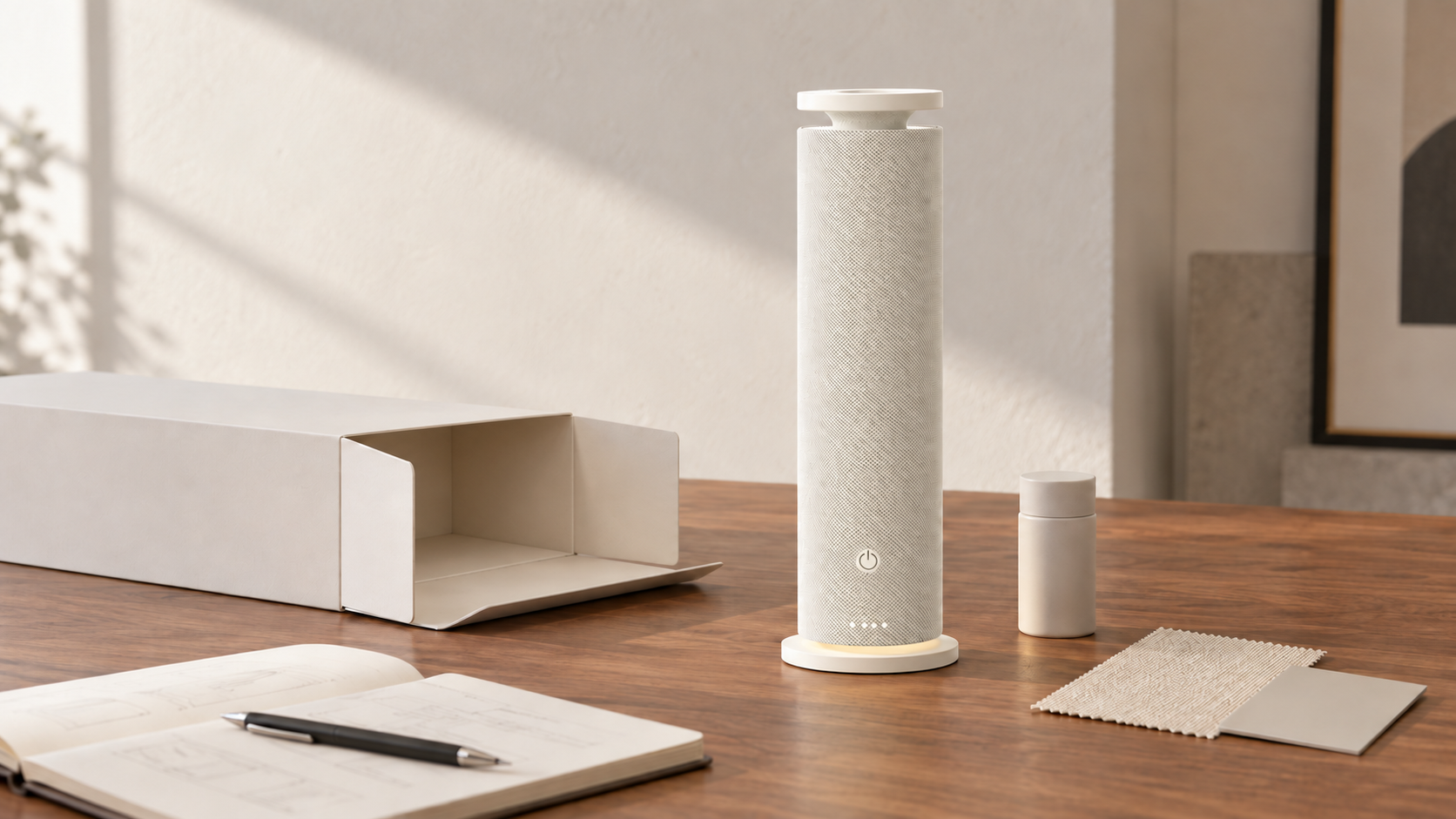
A successful OEM diffuser program starts before customization.
The first decisions should not be about logo placement, packaging color or how many functions can be added.
They should be about the product itself:
- Who will use it?
- Where will it be used?
- What fragrance will it deliver?
- How should the refill work?
- What level of scent output is appropriate?
- Which markets will the product enter?
- What should the complete ownership experience feel like?
These decisions determine whether an existing diffuser platform can be adapted successfully, whether deeper modification is required, or whether a new product architecture should be developed.
For fragrance and home-lifestyle brands, this distinction matters.
OEM development is not simply a process of putting a brand name on an existing machine.
It is the process of aligning fragrance, hardware, refill, industrial design, controls, compliance and commercial model around a clearly defined customer.
This guide provides a comprehensive framework for evaluating and developing a waterless diffuser OEM program, from the initial product brief through platform selection, prototyping, compliance and production.
Development overview:
Brief → Fragrance → Platform → Refill → Controls → Industrial Design → Prototype → Compliance → Pilot → Production
Start With the Product Brief
The most useful first document in an OEM diffuser program is not a quotation.
It is a clear product brief.
Before selecting a supplier or diffuser platform, define the basic commercial and user context.
A strong brief should answer questions such as:
Customer
- Who is the intended user?
- Is this primarily a home-fragrance customer, wellness customer or broader lifestyle consumer?
- Is the user already familiar with waterless scenting?
Environment
- Where will the product usually be placed?
- Bedroom?
- Living room?
- Home office?
- Entryway?
- Small hospitality space?
Channel
- Will the product be sold through e-commerce?
- Retail?
- Fragrance boutiques?
- Hospitality or wellness channels?
- Existing brand distributors?
Positioning
- Is the product intended to be entry-level, mid-market or premium?
- Is the diffuser expected to remain visible in the interior?
- How important are materials and finish to the brand proposition?
Commercial Model
- Is the diffuser a standalone product?
- Is it part of a refill system?
- Is recurring fragrance purchase important?
- Is the hardware intended to drive long-term fragrance consumption?
These answers immediately narrow the range of appropriate product platforms.
Without them, OEM discussions tend to become specification shopping.
Define the Fragrance Before Finalizing the Hardware
One of the most common development mistakes is selecting hardware first and treating fragrance compatibility as a later detail.
For waterless diffusion, fragrance is part of the technical system.
Different fragrance formulations may vary in:
- viscosity
- volatility
- solvent system
- fragrance concentration
- chemical composition
- residue behavior
These differences can affect:
- atomization
- consumption rate
- pump performance
- tubing
- seals
- plastics and elastomers
- cleaning
- long-term reliability
A diffuser that performs well with one fragrance may not perform identically with another.
The product brief should therefore define the intended fragrance medium as early as possible.
Questions include:
- Will the product use fragrance oil?
- Is the formulation already fixed?
- Will the brand offer one fragrance or a collection?
- Are different viscosity ranges expected?
- Is undiluted essential-oil compatibility actually required?
Waterless does not automatically mean compatible with pure essential oils.
If undiluted essential oils are part of the program, the hardware and material requirements may be different and should be evaluated separately.
The better sequence is:
define fragrance requirements → evaluate compatible hardware → validate the combination
rather than:
select diffuser → assume the fragrance will work
Choose the Right Platform, Not the Biggest Specification
Once the brief and fragrance requirements are clear, the next step is platform selection.
This is where many OEM programs become unnecessarily complicated.
The objective should not be to select the product with:
- the largest bottle
- the highest output
- the widest coverage
- the longest feature list
- the most complex app
The better question is:
Which existing platform is closest to the intended product experience?
For a home waterless program, possible formats may include:
- compact tabletop diffuser
- fabric-wrapped home diffuser
- portable or low-voltage format
- plug-in diffuser
- larger waterless platform for specific applications
Ultrasonic may still be the better choice for some programs, particularly when visible mist and water-based wellness rituals are part of the intended experience.
Technology should follow the brief.
The brief should not be rewritten around whatever product a supplier happens to have available.
Define the Refill Architecture Early
The refill system is often as important as the diffuser itself.
It affects:
- user convenience
- fragrance consumption
- packaging
- recurring revenue
- logistics
- brand differentiation
- long-term ownership experience
Important decisions include:
Bottle Size
A larger bottle can reduce refill frequency, but it can also increase product dimensions and cost.
A smaller bottle may support a more compact diffuser but require more frequent replacement.
Bottle Interface
Consider how the user installs and removes the refill.
The process should ideally be:
- intuitive
- clean
- secure
- difficult to install incorrectly
Standard vs Proprietary Refill
A standard bottle format may reduce development complexity.
A proprietary format may create a more controlled brand ecosystem, but can introduce additional tooling, packaging and supply-chain considerations.
Fragrance Switching
If the brand expects customers to change scents frequently, the system should consider:
- residual fragrance
- cleaning
- bottle removal
- transition between scents
- user instructions
These decisions should not be postponed until after the housing design is finished.
The refill architecture can influence the entire product structure.
Balance Output, Noise and Consumption
Waterless diffuser development involves trade-offs.
More output is not automatically better.
Increasing output may affect:
- fragrance consumption
- pump requirements
- acoustic performance
- perceived scent intensity
- refill frequency
A more powerful pump may improve atomization under some conditions, but may also introduce additional vibration or noise.
Longer duty cycles may create a stronger scent presence but increase fragrance consumption.
For home use, these factors need to be balanced.
A useful development question is:
What is the lowest level of technical complexity required to create the intended scent experience reliably?
This usually creates a better product than maximizing every specification independently.
Decide What Actually Needs to Be Customized
OEM does not mean every part of the product should be changed.
Customization should solve a commercial, functional or brand problem.
Possible areas include:
- logo
- housing color
- fabric or surface finish
- materials
- control interface
- indicator lighting
- timer logic
- fragrance bottle
- refill configuration
- packaging
- instructions
- power configuration
But every modification introduces some combination of:
- cost
- tooling
- validation
- lead time
- technical risk
- MOQ impact
A good development program distinguishes between customization that creates real value and customization that simply adds complexity.
For example, a new housing color may meaningfully improve brand fit with relatively limited technical impact.
Changing the refill mechanism or internal atomization structure is a very different level of project.
These should not be treated as equivalent OEM requests.
Understand the Three Levels of Product Development
It is useful to separate OEM development into three broad levels.
1. Existing Platform + Brand Customization
This is the simplest route.
Typical changes may include:
- logo
- color
- packaging
- instructions
- selected finish options
- approved control configuration
Advantages can include:
- lower development complexity
- shorter timeline
- less tooling
- lower technical risk
But the product remains fundamentally based on an existing supplier platform.
2. Modified Platform
This approach starts with an existing product architecture but changes selected parts of the experience.
Examples may include:
- housing modifications
- revised controls
- alternative materials
- different refill configuration
- modified lighting
- different power architecture
- more significant exterior redesign
This can create stronger differentiation without developing the entire technical platform from zero.
However, modification requires more validation.
Changes to housing, bottle interface, airflow, vibration behavior or controls may affect performance in ways that are not obvious at the beginning.
3. Custom Product / New Tooling
A fully custom product may be appropriate when an existing platform cannot meet the brief.
This route can involve:
- new industrial design
- custom tooling
- new mechanical architecture
- revised internal layout
- custom refill system
- new user interface
- deeper electronics development
This offers the greatest differentiation, but also increases:
- development cost
- tooling investment
- engineering work
- validation requirements
- lead time
- project risk
The right level of customization depends on the business case.
A custom tool should not be the default simply because it offers more design freedom.
Prototype Before Tooling
The prototype stage should answer questions, not just show what the final product might look like.
Different prototype stages may serve different purposes.
Functional Sample
Used to evaluate:
- atomization
- fragrance compatibility
- controls
- operating logic
- noise
- consumption
- refill handling
Appearance Sample
Used to evaluate:
- proportion
- materials
- finish
- color
- control placement
- visual integration
Integrated Prototype
Used to evaluate how the major product systems work together.
At this stage, the team can examine:
- fragrance + hardware
- refill + housing
- controls + user interaction
- power + portability
- appearance + maintenance access
It is much easier to correct these issues before production tooling is finalized.
Evaluate the Real Refill Experience
A refill mechanism can look simple in CAD and still feel awkward in real use.
During prototyping, test the actual sequence:
- Open the product.
- Remove the existing bottle.
- Install a new bottle.
- Close the product.
- Restart scenting.
Ask:
- Does the user understand what to do?
- Is the bottle easy to grip?
- Can fragrance contact the user’s hands?
- Can the refill be inserted incorrectly?
- Is the process too technical?
- Is cleaning required between scents?
- Are instructions obvious?
For a home product, this interaction may happen many times during the life of the diffuser.
It deserves the same attention as the exterior design.
Design the Controls Around Real Use
Control strategy should also be defined during development rather than inherited automatically from an existing supplier platform.
Possible control methods include:
- physical buttons
- remote control
- timer
- intensity levels
- app control
- scheduled operation
The more functions a product includes, the more important interface hierarchy becomes.
For many home users, the basic needs remain simple:
- turn it on
- adjust intensity
- set operating time
- turn it off
Advanced functions can still be useful, but they should not make these basic tasks harder.
OEM customization should therefore consider not just which functions are technically available, but which ones belong in the intended product.
Industrial Design Should Support the Technology
For home use, industrial design is not a final styling step.
It affects the practical experience.
Housing design can influence:
- access to fragrance
- vibration transmission
- stability
- indicator visibility
- control placement
- cable management
- cleaning
- perceived noise
- overall product scale
A material or visual choice should therefore be reviewed alongside engineering requirements.
For example, a more refined housing may improve interior integration, but it still needs to support:
- ventilation where required
- service access
- structural stability
- fragrance compatibility
- assembly
- manufacturing consistency
The objective is not simply to create a beautiful shell around existing components.
It is to develop the housing and technology as one product.
Define the Power Strategy
Power architecture should reflect the intended use environment.
Options may include:
- low-voltage adapter
- USB power
- rechargeable battery
- direct plug-in architecture
Each has implications.
Battery operation may improve placement freedom but adds:
- battery cost
- charging requirements
- runtime considerations
- battery aging
- additional safety requirements
A direct plug-in format removes charging but constrains placement.
An external adapter may simplify internal architecture but adds cable considerations.
For OEM development, power should be treated as part of the user experience rather than a late technical detail.
Identify Target Markets Before Compliance Work Begins
Compliance should not be treated as a box to check after product design is complete.
The target markets should be defined early.
Depending on the product and market, relevant requirements may involve:
- electrical safety
- EMC
- FCC
- CE-related requirements
- UKCA
- RoHS
- REACH
- WEEE
- applicable material or chemical requirements
Not every framework applies to every product.
Supplier-level certification also should not automatically be assumed to cover every exact OEM configuration.
Changes to:
- power supply
- electronics
- materials
- housing
- wireless functions
may affect what needs to be reviewed or tested.
The safer development principle is:
market definition → product configuration → compliance planning
rather than adding compliance after final design.
Packaging and Instructions Are Part of Product Development
Packaging is not only a branding exercise.
For a new scenting technology, it is part of user onboarding.
The customer may need to understand:
- what fragrance to use
- how to install the refill
- how to select intensity
- how to set a timer
- how to clean the product
- when to replace fragrance
- what not to put into the diffuser
Clear instructions can reduce misuse and customer-service issues.
The product, packaging and instructions should tell the same story.
If the hardware is simple but the instructions are confusing, the experience is still complicated.
Pilot Before Scaling
A sample that performs well on a development desk is not the same as a product validated for larger production.
Before committing to scale, an OEM program should validate the product in a configuration close to production intent.
Depending on the project, this may include a pilot or limited production stage.
Areas to evaluate can include:
- assembly consistency
- fragrance performance
- noise variation
- refill fit
- controls
- packaging
- transport
- cosmetic quality
- instructions
- repeated use
The objective is to discover problems while they are still manageable.
Moving directly from prototype approval into a large production commitment can turn small unresolved issues into expensive ones.
Supplier Selection Is Part of Product Development
The lowest quotation is not always the best supplier choice.
Neither is the longest specification sheet.
A supplier should be evaluated against the needs of the actual program.
Relevant factors include:
- suitability of existing platforms
- atomization experience
- engineering capability
- willingness to modify
- sample quality
- manufacturing consistency
- communication
- response to technical problems
- tooling flexibility
- MOQ
- lead time
- compliance readiness
Different suppliers may also be strong in different product categories.
One supplier may have a strong compact waterless platform.
Another may be better at commercial systems, plug-in formats or industrial design modification.
For a brand, this means supplier selection is not separate from product strategy.
It is part of it.
Do Not Let the Supplier Define the Entire Product Brief
Existing supplier platforms are useful starting points.
But there is a risk in letting the available product determine the entire program.
A supplier may naturally emphasize what already exists:
- current housing
- current pump
- current controls
- existing bottle size
- existing packaging format
The brand should instead continue asking:
Does this configuration support the product we actually want to build?
If the answer is no, the project may require:
- a different configuration
- another supplier platform
- targeted modification
- deeper development
OEM development works best when the product brief remains the decision framework.
The supplier platform should serve the brief, not replace it.
A Practical OEM Development Sequence
A useful way to organize a waterless diffuser program is:
Brief → Fragrance → Platform → Refill → Controls → Industrial Design → Prototype → Compliance → Pilot → Production
The process is not always perfectly linear.
A fragrance test may require platform changes.
A new refill design may affect the housing.
Compliance requirements may affect power architecture.
A prototype may reveal that the original noise target needs a different pump or enclosure.
Iteration is normal.
What matters is that the major decisions are made deliberately and validated before the project becomes difficult to change.
OEM Development Is a System, Not a Logo Exercise
A strong OEM diffuser program connects several decisions:
customer + fragrance + hardware + refill + controls + design + compliance + commercial model
If these decisions are made independently, the final product may feel fragmented.
If they are developed together, even an existing supplier platform can become a much more coherent brand product.
The goal is not maximum customization.
The goal is the right customization.
For home waterless scenting, that means creating a product that is technically appropriate, easy to live with, visually suitable for the home and commercially sensible for the brand behind it.