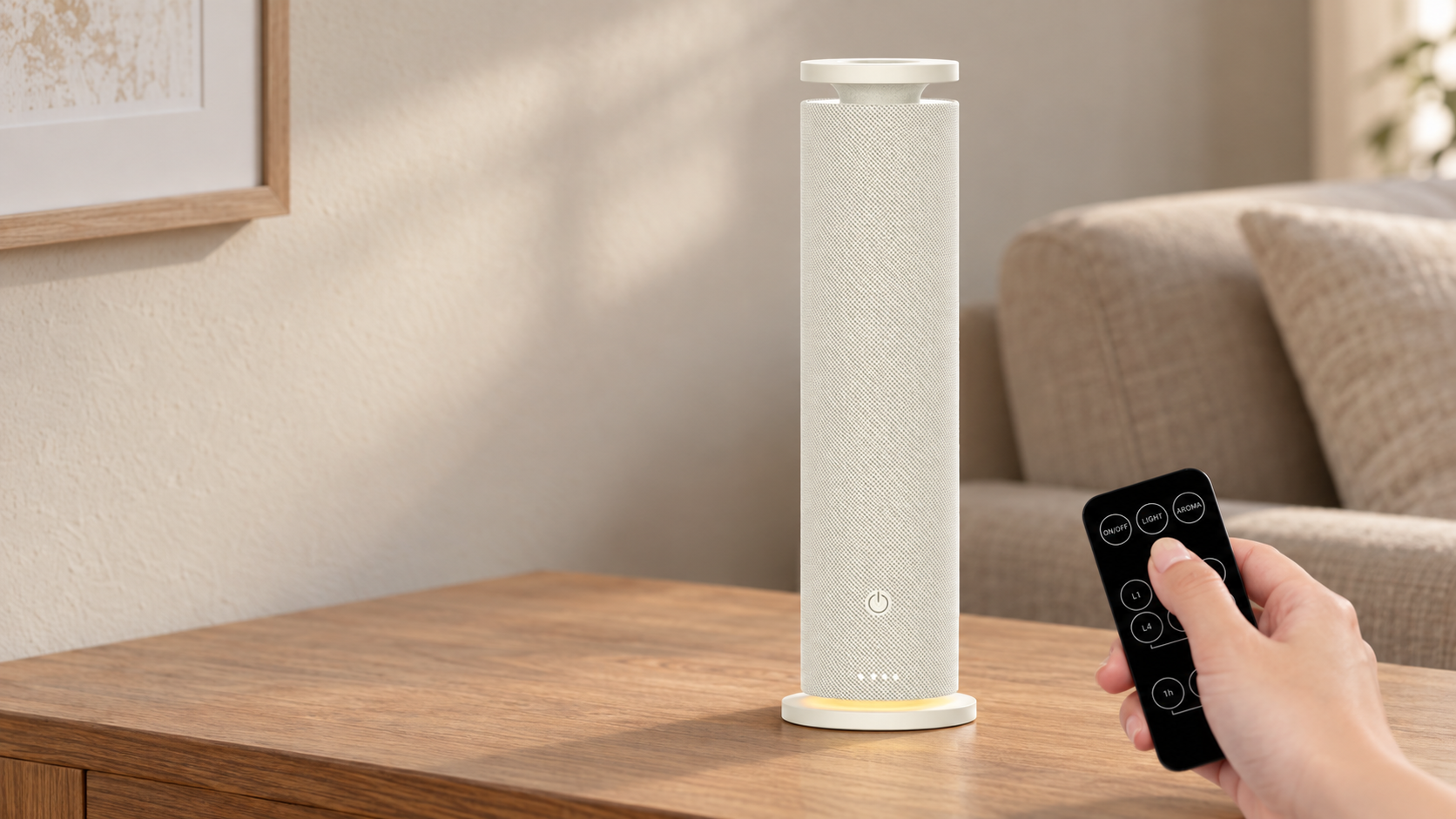
A good home waterless diffuser is not defined by how much technical capability it can carry.
It is defined by how well scent delivery, usability, design and fragrance compatibility work together in everyday life.
That distinction matters.
Many waterless scenting systems originated in commercial environments, where coverage, operating time and technical control were often the main priorities.
Home use requires a different development brief.
The product needs to fit smaller spaces, lower noise expectations, simpler routines and a much more design-conscious environment.
A successful home waterless diffuser should therefore be evaluated as a complete system rather than as a smaller version of commercial equipment.
Start With the User, Not Maximum Coverage
The first question should not be:
How many square feet can this diffuser cover?
It should be:
Where will the product actually be used, and what scent experience should it create there?
A bedroom, living room, home office and entryway have very different scenting needs.
In residential applications, maximum output can be less important than control.
A diffuser that is powerful enough for a large commercial space may be unnecessarily strong for a smaller room.
For home use, better product development usually starts with:
- appropriate scent output
- multiple usable intensity levels
- predictable operating cycles
- easy adjustment
- comfortable scent levels at close range
The objective is not to create the strongest diffuser possible.
It is to make scent easy to control.
Quiet Operation Is Part of the Product Experience
Noise can quickly determine whether a waterless diffuser feels appropriate for the home.
A mechanical sound that is acceptable in a retail space may become irritating when the device is placed beside a desk, sofa or bed.
This makes acoustic performance a core development consideration.
Important factors may include:
- pump selection
- atomization architecture
- vibration isolation
- enclosure structure
- operating cycle
- contact with furniture surfaces
The practical question is not simply whether the diffuser meets a particular noise number.
It is whether the sound remains unobtrusive in the environment where the product is intended to live.
A home diffuser can perform well technically and still fail if users prefer to turn it off because of the noise.
Fragrance Compatibility Should Be Defined Before Hardware Is Finalized
Waterless does not automatically mean compatible with every fragrance or essential oil.
This is one of the most important product-development issues.
Many waterless systems are designed around a specified fragrance oil or compatible fragrance medium.
Different formulations may vary in:
- viscosity
- volatility
- solvent system
- fragrance concentration
- chemical composition
- residue behavior
These differences can affect:
- atomization consistency
- fragrance consumption
- pump performance
- tubing
- seals
- plastics and elastomers
- cleaning requirements
- long-term reliability
Undiluted essential oils may create additional compatibility requirements and should not be assumed to work simply because a diffuser is waterless.
A waterless diffuser designed for fragrance oil should therefore not automatically be assumed to support pure essential oils.
The intended fragrance medium should therefore be defined early.
For a fragrance brand, this may mean evaluating the existing fragrance alongside the diffuser platform rather than selecting hardware first and testing compatibility later.
Hardware and fragrance should be developed as a system.
Refill Design Is as Important as Atomization
A technically capable diffuser can still create a poor user experience if refilling is inconvenient.
For home use, the refill process needs to feel simple, clean and intuitive.
Questions to consider include:
- How does the user access the fragrance bottle?
- Is replacement easy without tools?
- Can the bottle be installed incorrectly?
- Does fragrance spill during replacement?
- Can users switch scents easily?
- Is the refill size appropriate for home use?
- Is the bottle standard or proprietary?
- Is the refill clearly identified?
These decisions affect much more than convenience.
They influence packaging, fragrance consumption, recurring purchase behavior and the long-term relationship between the product and the customer.
For fragrance brands, refill architecture can become a central part of the commercial model.
A waterless diffuser is therefore not simply hardware.
It can become a device + fragrance + refill system.
Controls Should Be Simple Enough for Everyday Use
Commercial scenting systems may need advanced programming.
Most home products do not.
Complexity should only remain when it creates real user value.
For many home waterless diffusers, the most useful controls may be:
- power
- fragrance intensity
- timer
- simple scheduling
- optional app control
The user should be able to understand the basic product quickly.
Too many modes, buttons or programming steps can make an otherwise convenient technology feel difficult.
A good interface should answer three basic questions immediately:
How do I turn it on?
How do I make the scent stronger or lighter?
How long will it run?
If those answers are difficult to find, the control system is probably too complicated for everyday home use.
Portability Should Be Designed, Not Assumed
Compact products are easier to move, but true portability involves more than dimensions.
A diffuser intended to move between rooms should consider:
- overall size
- weight
- power connection
- fragrance bottle security
- leak resistance
- stability
- cable management
- ease of handling
A product that is small but awkward to unplug, easy to spill or unstable during movement is not truly convenient.
For tabletop products, portability can become a meaningful home advantage.
The user may want scent near a desk during the day and in another living space later.
The product should support that behavior naturally.
Power Architecture Matters More in the Home
Commercial systems often remain connected to a fixed power source.
Home products may need greater flexibility.
Depending on the intended use, options can include:
- USB power
- low-voltage adapters
- rechargeable battery systems
- plug-in formats
Each choice affects product size, cost, portability and user experience.
Battery operation can increase placement freedom, but it introduces additional considerations around runtime, charging, battery life and product safety.
A plug-in format can reduce charging requirements but limits placement.
There is no universally better option.
The right power architecture depends on the product format and intended daily use.
Industrial Design Is Functional, Not Cosmetic
A home diffuser lives in the interior.
That makes industrial design part of product performance.
Users may tolerate functional-looking equipment when it is hidden in a commercial installation.
They are less likely to tolerate it on a bedside table, desk or living-room shelf.
A home waterless diffuser should consider:
- scale
- proportion
- surface finish
- material
- controls
- cable visibility
- indicator-light brightness
- fragrance access
- visual balance with surrounding furniture
Design should also help reduce the perception of complexity.
Fabric finishes, refined matte surfaces, cleaner interfaces and more restrained proportions can all help the technology feel less like equipment.
But appearance should not compromise maintenance, airflow, access or technical reliability.
Good industrial design solves both visual and functional problems.
Indicator Lights Need Restraint
A small design detail can have a surprisingly large impact at home.
Bright LEDs that are acceptable in commercial environments can become distracting in bedrooms or low-light spaces.
Indicator lights should communicate necessary information without dominating the product.
Considerations may include:
- brightness
- color
- number of indicators
- whether lights can dim or turn off
- visibility in daylight
- visibility at night
This is a good example of how home product development differs from equipment design.
A technically useful feature can become a user-experience problem if it is not adapted to the environment.
Maintenance Should Be Clear and Manageable
Waterless diffusers remove the water-reservoir routine associated with ultrasonic products, but they are not maintenance-free.
Depending on the fragrance and atomization system, users may still need to clean:
- atomization components
- fragrance pathways
- bottles or adapters
- external surfaces
The maintenance routine should be considered during product development.
If cleaning is difficult, infrequent users may ignore it until performance declines.
A better product makes the required maintenance:
- easy to understand
- easy to access
- easy to perform
- clearly explained
Instructions should also distinguish normal maintenance from troubleshooting.
The simpler this experience is, the more practical the product becomes over time.
Consumption Matters Alongside Refill Size
Fragrance capacity is only one part of the refill experience.
Consumption rate matters as well.
Two products with similar bottle sizes can create very different ownership costs depending on:
- atomization method
- duty cycle
- intensity level
- fragrance viscosity
- operating time
For home users, refill frequency can strongly influence perceived value.
A product that consumes fragrance quickly may feel expensive even if the hardware is competitively priced.
This means product development should consider not only hardware cost, but the full ownership model:
device price + refill cost + refill frequency
For fragrance brands, this balance is especially important.
Repeat purchase is valuable only if the refill experience feels reasonable to the customer.
The Product Should Be Stable Across Fragrance Variations
A home fragrance program may eventually include multiple scents.
That creates another technical challenge.
Different fragrance formulations can behave differently in the same hardware.
A diffuser that performs well with one fragrance should not automatically be assumed to perform identically with another.
A broader fragrance program may therefore require testing across:
- lighter formulations
- heavier formulations
- different viscosity ranges
- different fragrance families
- different concentration levels
This is particularly important when the diffuser is intended to support a fragrance collection rather than a single scent.
The more fragrances a brand intends to offer, the more important platform validation becomes.
Safety and Compliance Should Be Considered Early
Home products enter a different regulatory and user environment than commercial equipment.
Power configuration, electronics, materials and intended markets all affect compliance requirements.
Depending on the product and destination market, relevant considerations may include:
- electrical safety
- EMC
- RoHS
- FCC
- UKCA
- REACH
- WEEE
- applicable material or chemical requirements
These frameworks are not interchangeable, and not every requirement applies to every product or market.
The important development principle is simple:
Compliance should be considered during product definition, not added at the end.
Power architecture, component choice and material selection can all become more difficult or expensive to change after tooling is finalized.
For OEM programs, target markets should therefore be identified early.
A Good Home Diffuser Needs the Right Balance
A home waterless diffuser is a system of trade-offs.
More output may increase coverage but also increase fragrance consumption.
A larger bottle may reduce refill frequency but increase product size.
A more powerful pump may improve atomization but increase noise.
Battery operation may improve portability but add cost, weight and charging requirements.
More functions may improve flexibility but make controls harder to understand.
This is why good product development is not about maximizing every specification.
It is about balancing the specifications around the intended user.
The strongest product is often not the one with the longest feature list.
It is the one in which the major choices make sense together.
What Fragrance Brands Should Evaluate
For a fragrance brand considering a home waterless diffuser, the development brief should answer several questions before selecting a final product platform.
Fragrance
- What fragrance medium will be used?
- Is the formulation already fixed?
- Will multiple fragrances be offered?
- Is pure essential-oil compatibility required?
User Experience
- Where will the diffuser be used?
- How often will users interact with it?
- Should it be portable?
- How quiet does it need to be?
- What level of control is appropriate?
Refill
- What refill size makes sense?
- How should bottles be installed?
- How frequently should they be replaced?
- Is the refill system proprietary or standard?
Product Design
- Should the diffuser remain visible in the home?
- What materials and finishes fit the brand?
- How prominent should controls and indicator lights be?
Market
- Which countries will the product enter?
- Which plug or power configuration is required?
- Which compliance requirements apply?
Commercial Model
- What should the hardware cost?
- What should the refill cost?
- How does the product support repeat fragrance purchase?
These questions are often more useful than comparing products only by capacity, wattage or maximum coverage.
The Best Home Waterless Diffuser Is Designed as a System
The best home waterless diffuser is not simply a smaller scent machine.
It is a coordinated product system.
Fragrance, atomization, pump, refill, controls, power, industrial design and maintenance all affect one another.
For brands, this means selecting a supplier platform is only the beginning.
The real development work is determining how that platform should be configured around the intended fragrance, user, interior environment, market and business model.
That is what turns waterless scenting technology into a genuine home product.